Heard of dysarthria? Know what dysarthria means?
Read this blog to find out whether dysarthria is:
- A problem with maths 🧮
- Something to do with colour 🎨
- Something else entirely…🤔
A huge thank you to Alistair Mullis, Dr Claire Mitchell and the HEARD dysarthria group for providing the majority of content for this blog.
What is dysarthria?
“Dysarthria affects everything I do”
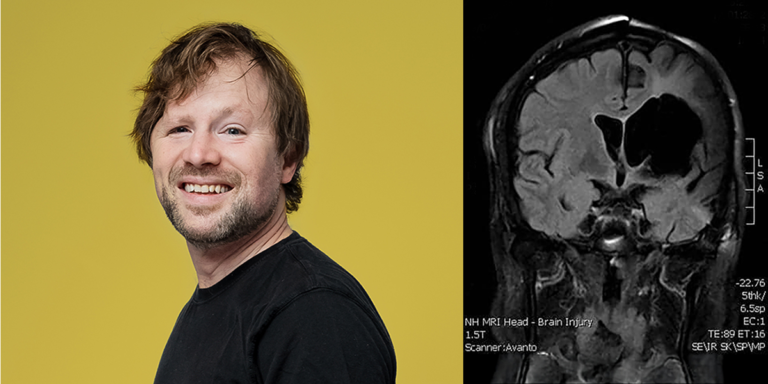
Alastair Mullis (lives with dysarthria)
😶 Dysarthria happens after brain injury e.g., stroke, or with progressive neurological conditions such as Parkinson’s and Motor Neurone Disease
😶 Dysarthria is the difficulty in making clear speech following a stroke or other medical conditions
😶 Dysarthria is almost always a mechanical, muscular problem. It is less complicated than some other communication differences, but can be just as difficult to cope with.
Dysarthria makes speech unclear by affecting the muscles that let a person form words. It doesn’t affect intelligence, but can go alongside other cognitive communication differences. Dysarthria can change how the voice sounds completely, or can have symptoms like different speech volume, speed or poor breath control.
Holding a simple conversation with dysarthria can be much, much more tiring and difficult. Forming words can be physically fatiguing and the extra attention and effort required to make speech as intelligible as possible adds a huge cognitive load. Added to the fact that you may have to be repeating yourself and checking and rechecking often make simple tasks into a real burden.
Your voice is an incredibly personal and intimate part of who you are. Sounding suddenly different, in a way that is often seen as ‘worse’ can be a real knock to confidence. People have said that people with dysarthria can sound drunk, like a person with a learning disability, deaf or stupid. This can make everyday conversations awkward for everyone, and can lead really unhelpful and difficult interactions.
🎯 How common is dysarthria?
Common. More than 50% of people who have a stroke have dysarthria (Mitchell et al., 2021).
🏥 100,000 people have a stroke in the UK each year, and 1.4 million stroke survivors live in the UK (The Stroke Association statistics).
🏥 This means 700,000 people in the UK are living with dysarthria, after stroke, with an additional 50,000 new cases each year.
That is a lot of people – and stroke is becoming more, not less common (NHS England 2024). And these figures do not include people living with dysarthria due to head injury, Parkinson’s, Motor Neuron Disease, Multiple sclerosis… the list goes on.
Living with dysarthria by Alistair Mullis
Dysarthria, when it happens with Stroke, is usually not the only issue with which one copes. For example, I have:
- difficulty eating and drinking,
- have trouble with sight,
- am very unbalanced and
- walk with a very bad limp.
Some people can’t walk and can’t eat or drink.
Dysarthria affects everything I do.
I don’t like to have conversations on the phone. I can’t see the person to whom I am speaking and they can’t see me. Some people 👄 lip read me and that is very difficult on the phone
I look normal
and therefore some people treat you as normal until they realise speech is a problem
Some people then treat you as an idiot or shout. I am neither stupid nor deaf.
🎓 Before my stroke I was a senior academic.
🧠 My thinking is generally good. Don’t treat me as an idiot.
Speaking requires a lot of effort from me. Trying to articulate words costs me a lot.
I know it’s difficult for the other person. That makes it worse. Not being understood can strip away your confidence.
Dysarthria makes me feel embarrassed.
Sometimes I also don’t want to embarrass other people. People, often good people, speak to my carer. I get ignored, talked over.
Alastair Mullis (lives with dysarthria)
I know that happens to people in 👨🏿🦽➡️wheelchairs but I am still a person– I have views. It may take longer to get the words out but being spoken about as though I don’t exist is hard. Before my stroke, nobody had any problems understanding me. Now they do. That is not an easy thing to live with.
With speaking being a problem, I withdraw. It is much easier not to try to speak to others. I know it can embarrass them so it’s easier if I don’t speak. I have in this sense gone from someone who spoke to others a lot to someone who speaks as little as possible.
I know it is bad for me- we are social animals after all- but it’s just easier not to speak.
Show us the lemonade! Alistair’s top communication tips…
The Lemonade is you 🫵.
1. Make sure you are not distracted
2. Listen and look at the speaker, rather than their carer.
3. Give the speaker more time.
4. Intelligent guesswork about what the speaker has said.
5. Ask me about my speech.
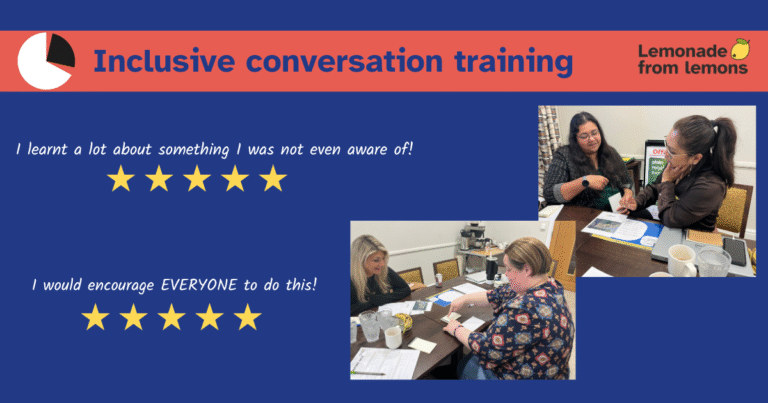
Remember, if you want disability awareness training for your organisation that focuses on inclusive communication, delivered by experts in the field get in touch! #inclusivecommunicationtraining
Our Inclusive communication training uses:
🍋 communication partner training principles,
🍋 behaviour change theory,
🍋 adult learning principles and
🍋 creative health
To deliver: the knowledge, skills and the motivation to make your team into skilled communicators and boost your organisations disability awareness.
📚 Useful links
HEARD (dysarthria) group Manchester University: A wonderful group of lived experience experts championing the impact of living with dysarthria after stroke.
Managing dysarthria in Multiple Sclerosis
Look out for our next blog about communication differences…